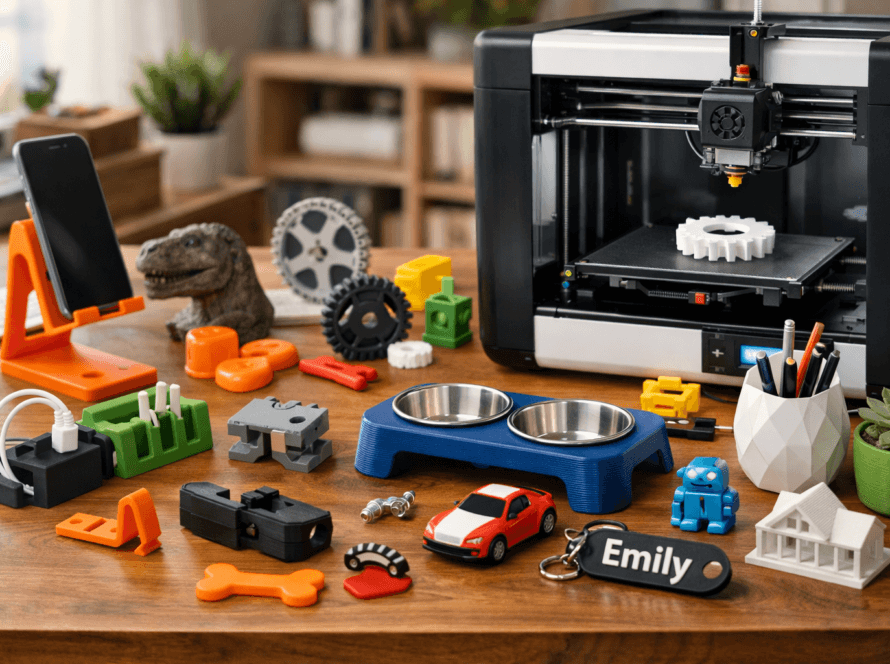
Just ten years ago, 3D printing was seen as an expensive toy for engineers and tech enthusiasts. Today, it is a practical tool used by designers, architects, doctors, engineers, and small manufacturing companies. Yet behind the familiar term “3D printing” lies not one technology, but several fundamentally different approaches.
Each of them serves specific purposes, uses different materials, and affects the final result in its own way. To make informed decisions, it is important to understand how these technologies actually work.
Why 3D Printing Is Not a Single Technology
3D printing is a general term for additive manufacturing, where objects are created layer by layer from a digital model. However, the materials involved can vary greatly. In some cases, melted plastic is used; in others, liquid photopolymer resin or powder that supports the part during printing.
Because of this, each technology has evolved to solve specific problems. Some focus on affordability and speed, others on precision and surface quality, and some on design freedom and functional performance.
FDM: The Most Practical and Universal Technology
FDM printing became the most widespread technology for a reason. Its principle is simple and intuitive: a plastic filament is heated, melted, and extruded through a nozzle to form an object layer by layer.
This technology is most often used for functional parts. It is well suited for housings, brackets, technical components, and prototypes where strength and practicality matter more than a flawless surface finish. FDM printers are relatively easy to maintain, and the wide range of plastics allows engineers and designers to tailor material properties to real-world conditions.
At the same time, FDM has its limitations. Layer lines are usually visible, and part strength can depend on print orientation. Even so, FDM remains the most versatile solution for everyday manufacturing tasks.
Photopolymer Printing: Precision and Detail
Photopolymer technologies work on a completely different principle. Instead of solid plastic, they use liquid resin that hardens when exposed to ultraviolet light.
In SLA printing, a laser selectively cures each layer of resin, achieving extremely high accuracy and smooth surfaces. Parts produced this way often resemble injection-molded components and are widely used where visual quality is critical.
DLP printing follows a similar concept but cures entire layers at once using a digital projector. This significantly increases printing speed and ensures consistent results, making it popular in dental and small-scale production environments.
LCD printing, also known as MSLA, has become the most accessible resin-based technology. By using an LCD screen to shape UV light, it delivers fine detail at a relatively low cost, though it still requires careful post-processing.
The main drawback of photopolymer printing is the need for washing and additional curing. In addition, not all resins are suitable for long-term mechanical stress.
Powder-Based Technologies and Design Freedom
SLS printing occupies a unique position among additive manufacturing technologies. In this process, parts are formed within a bed of powder that supports the object as it takes shape. This allows for complex geometries without the need for support structures.
Thanks to this design freedom, powder-based printing is often used for functional parts with intricate shapes. However, the high cost of equipment and infrastructure means it is mainly used in industrial environments.
A related technology, MJF, offers higher speed and more consistent quality but remains a closed and expensive ecosystem.
Material Jetting
There are also technologies where material is deposited in tiny droplets, similar to an inkjet printer. This approach makes it possible to combine different materials and colors within a single model, producing highly realistic parts with excellent surface quality.
Despite these advantages, material jetting remains a niche solution due to the high cost of equipment and consumables.
Experimental and Emerging Technologies
Beyond established methods, more specialized areas continue to develop. These include construction-scale 3D printing, bioprinting, and experimental material systems. While still uncommon in everyday production, these technologies are shaping the future of additive manufacturing.
How to Choose the Right Technology
Choosing a 3D printing technology always starts with the intended application. FDM is typically selected for practical parts and prototypes. Photopolymer printing is preferred when fine detail and appearance are important. Powder-based technologies are chosen when maximum design freedom is required.
3D printing is not a universal solution, but a toolbox of methods, each effective in its own context.
Why FDM Printing Remains the Most Practical Choice
Despite the rapid development of advanced and high-precision technologies, FDM printing continues to be the most practical option for many real-world applications. It offers a balance of affordability, reliability, and predictable results, which is especially valuable for engineering and business use.
FDM makes it possible to produce durable parts from modern engineering plastics in a matter of hours, without complex logistics or long lead times. For this reason, it is widely used not only for prototyping, but also for small-batch production and functional components where efficiency and cost control matter most.